
Key takeaways
- Price range (2026): Reach-in retarder provers cost $5,500-$12,000; roll-in/trolley models cost $12,000-$25,000+ in Australia.
- Primary decision factor: Capacity in trays or racks - a reach-in holds 10-20 trays for small bakeries; a roll-in accepts full trolleys of 40-80+ trays for production environments.
- If your bakery starts production before 4 am - a retarder prover eliminates night shifts by holding dough at retard temperature overnight and triggering the proving cycle on a timer to have dough ready at your start time.
- Key spec: Programmable multi-phase cycling (retard-hold-prove) is the feature that separates a retarder prover from a standard prover or coolroom - without it, you are buying a cabinet, not a production tool.
- Humidity control: Look for units with active humidity generation (steam or atomiser), not passive humidity from a water tray. Active humidity prevents surface crusting on enriched doughs.
- Compliance: Must meet AS/NZS 60335.2.89 (commercial refrigerated cabinets) and FSANZ food-contact surface requirements. Installation by a licensed refrigeration technician is required in all states.
- Energy draw: Compressor and heating elements together draw 1.5-4.5 kW - annual energy cost is $500-$1,500 depending on cycle frequency and ambient temperature.
How to choose the right retarder prover for your bakery (2026 buying guide)
A retarder prover gives bakeries control over fermentation timing that no other single piece of equipment can deliver. By holding dough at 2-4°C during retard phase and automatically warming to 28-38°C for proving, it decouples dough preparation from baking schedules - allowing overnight retardation that produces dough ready to bake at 5 am without a 2 am start. For Australian bakeries facing labour shortages across NSW, VIC and QLD in 2026, eliminating or reducing early-morning shifts is not just a convenience: it is a staffing strategy that directly impacts retention and wage costs.
This guide walks bakery owners, head bakers and procurement managers through configuration, specifications, pricing and supplier evaluation for retarder provers in Australia. For running cost and financing detail, see the retarder prover cost guide. If you already know your configuration, get quotes for retarder provers from verified Australian suppliers on HospitalityHub.
Operations where retarder provers are the standard choice:
- Artisan bakeries producing sourdough, baguettes and enriched breads on overnight retard programs
- In-store bakery departments in supermarkets with fixed morning bake-off schedules
- Wholesale bakeries managing multi-product proving across staggered delivery windows
- Patisseries running croissant and danish programs that require cold retard for lamination quality
- Pizza operations pre-proving dough balls overnight for next-day service
Choose your configuration
Before costing anything, confirm which configuration suits your daily production volume and floor plan. Your choice here sets your price bracket and most of the specs that follow.
Type | Key Spec | Best For |
|---|---|---|
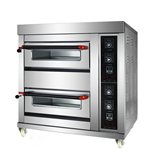
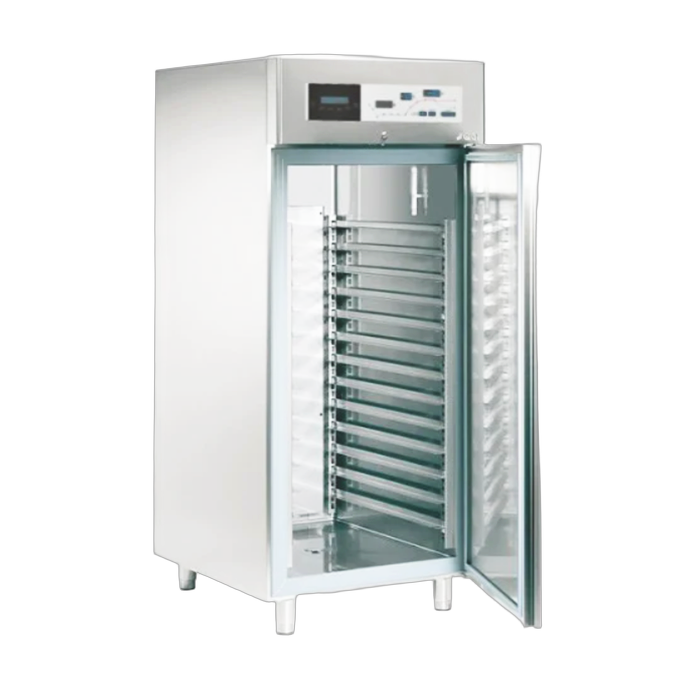
Reach-in (single door) | 10-20 trays, 1.5-2.5 kW, 700-900mm wide | Small bakeries, cafes and pizza operations processing 20-60 kg of dough per day |
Reach-in (double door) | 20-40 trays, 2-3.5 kW, 1400-1600mm wide | Mid-size bakeries running 2-4 dough types on staggered proving schedules |
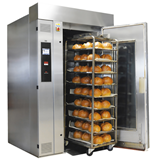
Roll-in (single rack) | 1 trolley (40-80+ trays), 3-4.5 kW | Production bakeries, wholesale operations, supermarket in-store bakeries with rack oven workflow |
Roll-in (multi-rack) | 2-4 trolleys, 4-6 kW+ | Large wholesale bakeries, multi-shift production environments with 200+ kg/day throughput |
If your bakery processes under 60 kg/day across 1-2 dough types, a reach-in single door at $5,500-$10,000 handles it. Above 80 kg/day or where your workflow uses rack trolleys, a roll-in at $12,000-$25,000+ integrates directly with your existing oven loading process.
Evaluate the key specifications
With your configuration confirmed, these are the specs that determine whether a given model fits your production schedule and dough quality requirements.
Specification | Typical Range | Buyer Consideration |
|---|---|---|
Phase cycling | 3-7 programmable phases | Minimum 3 phases (retard-hold-prove) required. 6-7 phase units (pre-cool, retard, hold, pre-heat, prove, post-prove, bake-ready alarm) offer the most scheduling flexibility. |
Temperature range | -5°C to +40°C | Retard at 2-4°C, prove at 28-38°C. Sub-zero capability adds flexibility for extended cold retards (24-72 hours) |
Humidity control | Passive (water tray) or active (steam/atomiser) | Active humidity prevents surface crusting on enriched doughs and croissants - passive is inadequate for laminated products |
Insulation thickness | 50-80mm polyurethane | Thicker insulation reduces compressor cycling in warm climates (QLD, NT, northern NSW) and lowers energy cost by 15-25% |
Control interface | Basic digital or touchscreen programmable | Touchscreen models store 10-50+ programs per dough type - eliminates operator error on overnight cycles |
Compressor type | Standard or inverter | Inverter compressors modulate output instead of cycling on/off - reducing energy use by 20-30% and temperature fluctuation inside the cabinet |
Understand the full cost breakdown (2026 prices)
Purchase price is only part of the picture - most cost models that get rejected at approval stage have missed the running cost layer. Here is the full breakdown.
Category | Price Range (AUD) | Typical Configuration |
|---|---|---|
Reach-in (single door, new) | $5,500-$12,000 | 10-20 trays, basic digital control, passive or active humidity |
Roll-in (single rack, new) | $12,000-$25,000+ | Full trolley capacity, touchscreen programmable, active humidity, inverter compressor |
Used/refurbished | $3,000-$12,000 | Inspect compressor condition, door seals, humidity system, control panel and temperature accuracy |
Annual energy | $500-$1,500 | 1.5-4.5 kW compressor + heating, cycling throughout overnight retard-prove programs |
Annual maintenance | $300-$800 | Compressor service, door seal replacement, humidity system descaling, temperature calibration |
The most common mistake is buying a retarder prover without active humidity control and running enriched doughs overnight. Passive humidity from a water tray cannot maintain the 75-85% RH needed to prevent surface crusting on croissants and brioche - the result is a dry skin that cracks during proving and produces an uneven bake. Active humidity adds $1,000-$3,000 to the purchase price but eliminates product waste that can exceed $2,000/year on a busy croissant line. For reach-in models at $5,500-$12,000, get quotes for retarder provers from verified Australian suppliers.
Plan the asset (depreciation and financing)
The ATO effective life for commercial refrigerated cabinets is 10 years. Under diminishing value, the depreciation rate is 20%; prime cost is 10% per annum. Reach-in retarder provers under $20,000 qualify for the instant asset write-off in the year of purchase for eligible small businesses.
For bakeries testing overnight retard programs for the first time, a 12-24 month lease at $60-$250/week avoids the capital commitment while validating the production benefit. A retarder prover that eliminates one early-morning labour shift at $25-$35/hour saves $12,000-$18,000/year - making payback on a $12,000-$20,000 unit achievable within 12-18 months at typical bakery volumes.
Evaluate suppliers
You are ready to go to market. Use this checklist to assess each supplier against the same criteria.
Factor | What to Ask |
|---|---|
Phase cycling | How many programmable phases does this model support? Can I set different programs for different dough types? |
Humidity system | Is humidity control active (steam/atomiser) or passive (water tray)? What RH range can it maintain? |
Tray/trolley compatibility | Does this unit accept my existing tray sizes and rack trolleys? What is the maximum load weight? |
Warranty | What warranty period is offered? Is the compressor covered separately? |
Spare parts | Are door seals, humidity components and compressor parts stocked in Australia? |
Service network | Do you have refrigeration technicians in my state? What is the typical response time? |
Installation | Is delivery, positioning and commissioning included? Does the unit require a dedicated power circuit? |
Demo | Can I run a test overnight retard-prove cycle with my actual dough before purchasing? |
Lead time | Is this model ex-stock in Australia or imported to order? |
Finance | Do you offer lease, hire-to-own or equipment finance arrangements? |
Frequently asked questions
What capacity retarder prover does a typical bakery need?
A bakery producing 50-80 kg of dough per day typically needs a reach-in with 15-20 tray capacity ($7,000-$12,000). Above 100 kg/day or where rack trolleys are part of the oven workflow, a roll-in at $12,000-$25,000 is the standard choice.
How does a retarder prover eliminate early morning shifts?
The unit holds dough at 2-4°C overnight (retard phase) and automatically warms to proving temperature (28-38°C) on a timer - so dough is ready to bake when the first baker arrives at 5 am instead of requiring a 2 am start for mixing and proving.
What is the difference between a retarder prover and a standard prover?
A standard prover maintains warm temperature and humidity for active proving only. A retarder prover adds refrigeration for cold retardation plus programmable multi-phase cycling - allowing dough to be held at near-freezing and automatically transitioned to proving on a schedule.
What compliance requirements apply to retarder provers in Australia?
Units must comply with AS/NZS 60335.2.89 (commercial refrigerated cabinets) and AS/NZS 60335 (general electrical safety). Installation must be performed by a licensed refrigeration technician. All food-contact surfaces must meet FSANZ Standard 3.2.3.
How quickly does a retarder prover pay for itself?
If the unit eliminates one early-morning shift at $25-$35/hour for 5-6 hours, the annual saving is $12,000-$18,000. A $12,000-$20,000 retarder prover typically pays for itself in 12-18 months through labour savings alone - before accounting for improved dough quality and reduced waste.
What matters most
- Reach-in models at $5,500-$12,000 suit bakeries processing under 80 kg/day; roll-in models at $12,000-$25,000+ suit production environments
- Programmable multi-phase cycling (retard-hold-prove) is the defining feature - without it, you are buying a prover or a fridge, not a retarder prover
- Active humidity control prevents surface crusting on enriched and laminated doughs - passive humidity is inadequate for croissants and brioche
- Eliminating one early-morning shift saves $12,000-$18,000/year - making payback achievable in 12-18 months
- Inverter compressors reduce energy cost by 20-30% and maintain more stable cabinet temperature
- Installation must be by a licensed refrigeration technician under AS/NZS 60335.2.89
Most buyers shortlist 2-3 models after getting an initial quote.
Don't waste time contacting suppliers individually. HospitalityHub gives you direct access to verified Australian retarder prover suppliers - where hospitality buyers request and compare multiple quotes so they can buy with confidence.
- Get quotes for retarder provers - contact multiple verified suppliers with a single enquiry
- Compare models - filter by capacity, phase cycling and region
- Contact suppliers directly - speak to specialists who service your state